Applications / Molecular Interaction Profiling
One kinetic platform.
Eight molecular classes.
Measure affinity, kinetics and selectivity across proteins, antibodies, VHHs, peptides, small molecules, DNA and RNA, glycans and aptamers with high-density, label-free SPRi.
- Array-scale
- Parallel molecular comparison
- Real-time
- Association and dissociation
- Label-free
- Native interaction measurement
MOLECULAR COVERAGE
- 01Proteins
- 02Antibodies
- 03VHH
- 04Peptides
- 05Small molecules
- 06DNA / RNA
- 07Glycans
- 08Aptamers
01 / ANTIBODY
Compare antibody binding
beyond a single affinity value.
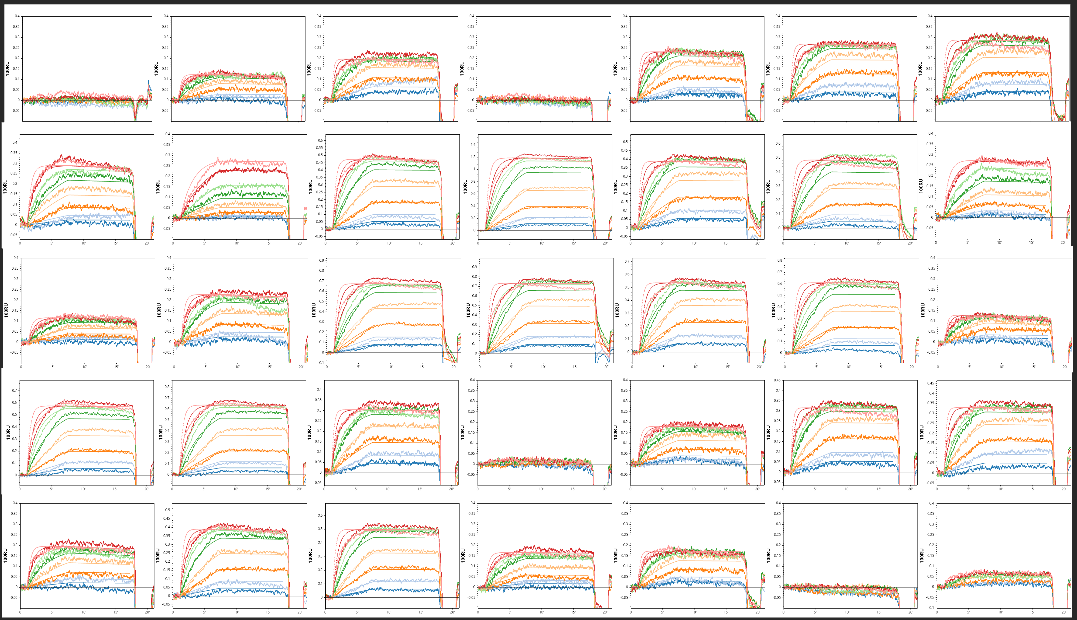
Parallel sensorgrams show how each antibody reaches and maintains binding. Compare affinity, association, dissociation and specificity within one experimental framework.
- IgG and scFv formats
- Target-panel specificity
- Epitope-competition workflows
- Candidate ranking
02 / VHH
Move from VHH sequence
to comparable kinetic data.
Connect sequence-diverse VHH candidates to parallel expression, purification, quality control and SPRi measurement without emphasizing a single endpoint signal.
- Parallel cell-free protein synthesis
- Purification and quality control
- Concentration-resolved sensorgrams
- Binder and non-binder separation
03 / PEPTIDE
Build peptide interaction maps
at array scale.
Compare large peptide panels against multiple reader proteins to reveal binding strength, selectivity and interaction patterns across a consistent surface.
- Interaction discovery
- Affinity profiling
- Reader-panel selectivity
- Library-level heatmaps
- 550+
- Peptides in a representative published program
- 8
- Reader proteins
- ~4,500
- Interactions in one experiment
04 / GLYCAN
Resolve glycan recognition
without fluorescent labels.
Direct photocrosslinking immobilizes unmodified glycans for real-time measurement of glycan–antibody and glycan–protein interactions.
- Direct photocrosslinking
- Label-free recognition
- Surface-density comparison
- Affinity and selectivity profiles
SHARED EXPERIMENTAL FRAMEWORK
Different molecules.
One comparable workflow.
- 01Define the library
Confirm molecular formats, targets, controls and comparison goals.
- 02Prepare the array
Create a controlled, high-density layout on the sensor surface.
- 03Measure by SPRi
Record association and dissociation across the array in real time.
- 04Compare the data
Return sensorgrams, kinetic parameters, heatmaps and ranked results.
CONSISTENT DATA OUTPUT
From raw response
to molecular decisions.
Every format is connected to the same core data structure for clear comparison and downstream prioritization.
- Concentration-resolved sensorgrams
- KD, kon and koff
- Replicate-level results
- Heatmaps and molecular profiles
- Ranked dataset and report