PLEXERA®

Technology / Integrated platform

The technology behind
array-scale kinetics.

Plexera combines high-density microarrays, surface chemistry, wide-field SPR imaging and parallel data analysis to measure thousands of molecular interactions in real time.

  1. 01Molecule preparationSequences and molecular libraries
  2. 02Array fabricationHigh-density microarray printing
  3. 03Surface chemistryApplication-specific capture
  4. 04SPRi detectionWide-field, label-free imaging
  5. 05Kinetic analysisKD, kon, koff and Rmax

SURFACE PLASMON RESONANCE IMAGING

Wide-field imaging across
the entire microarray.

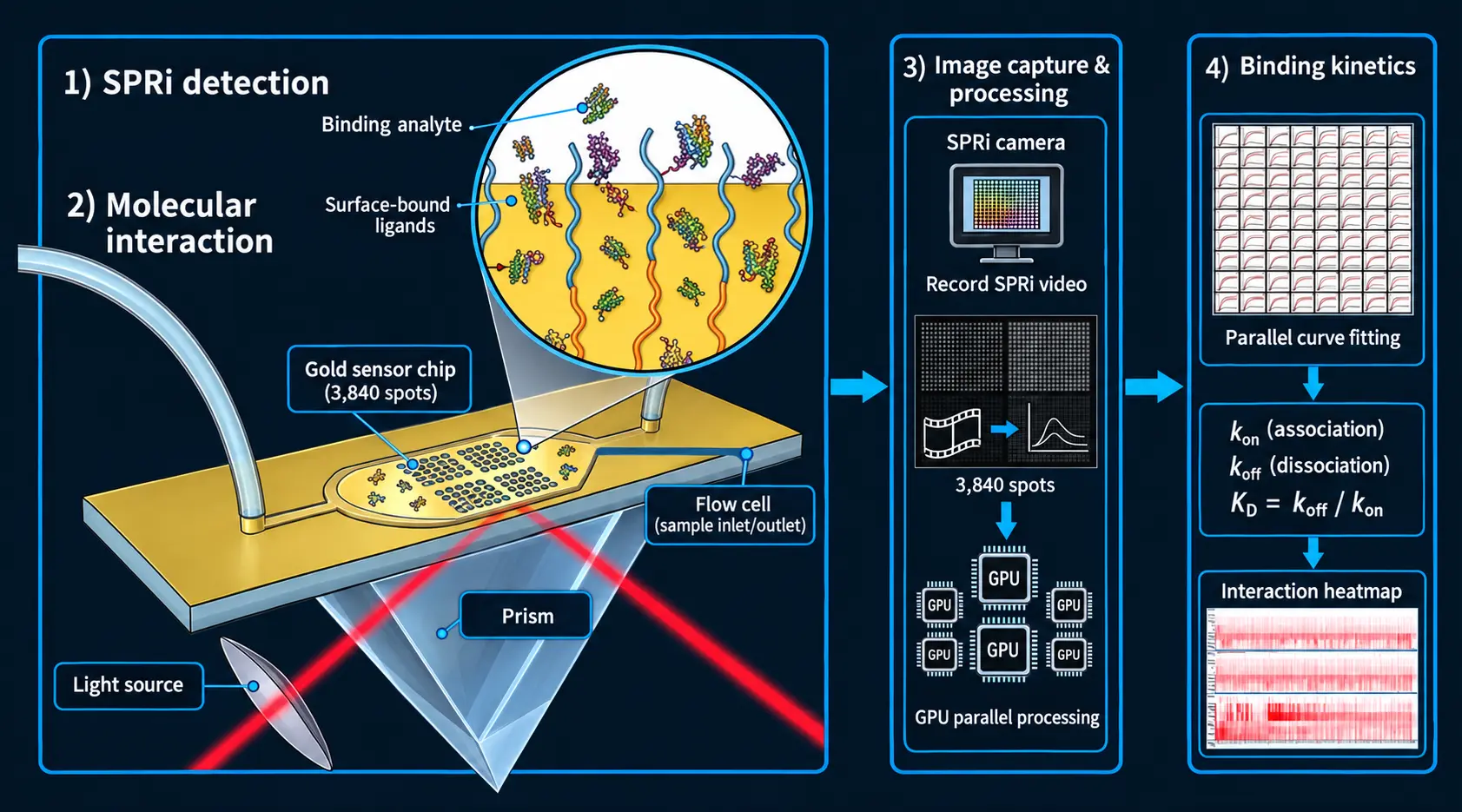
Prism-coupled light excites surface plasmons at the sensor surface. As molecules bind and dissociate, changes in the local refractive index alter the reflected light across each sensing spot.

The image sequence preserves the interaction over time and supports parallel signal extraction across the array.

SPRi optical path showing the light source, prism, sensor chip, image capture and kinetic analysis
Optical excitation, on-chip interaction, image processing and kinetic analysis

WHY IMAGING SCALES

From separate channels
to an imaging surface.

CONVENTIONAL CHANNEL FORMAT

Separate measurement paths

A limited number of flow channels produces a smaller set of responses per run.

PLEXERA SPRi FORMAT

One full imaging surface

Wide-field detection records thousands of sensing positions across the same chip.
3,840
Current sensing spots per chip
Real-time
Association and dissociation
Parallel
Signal extraction and curve fitting
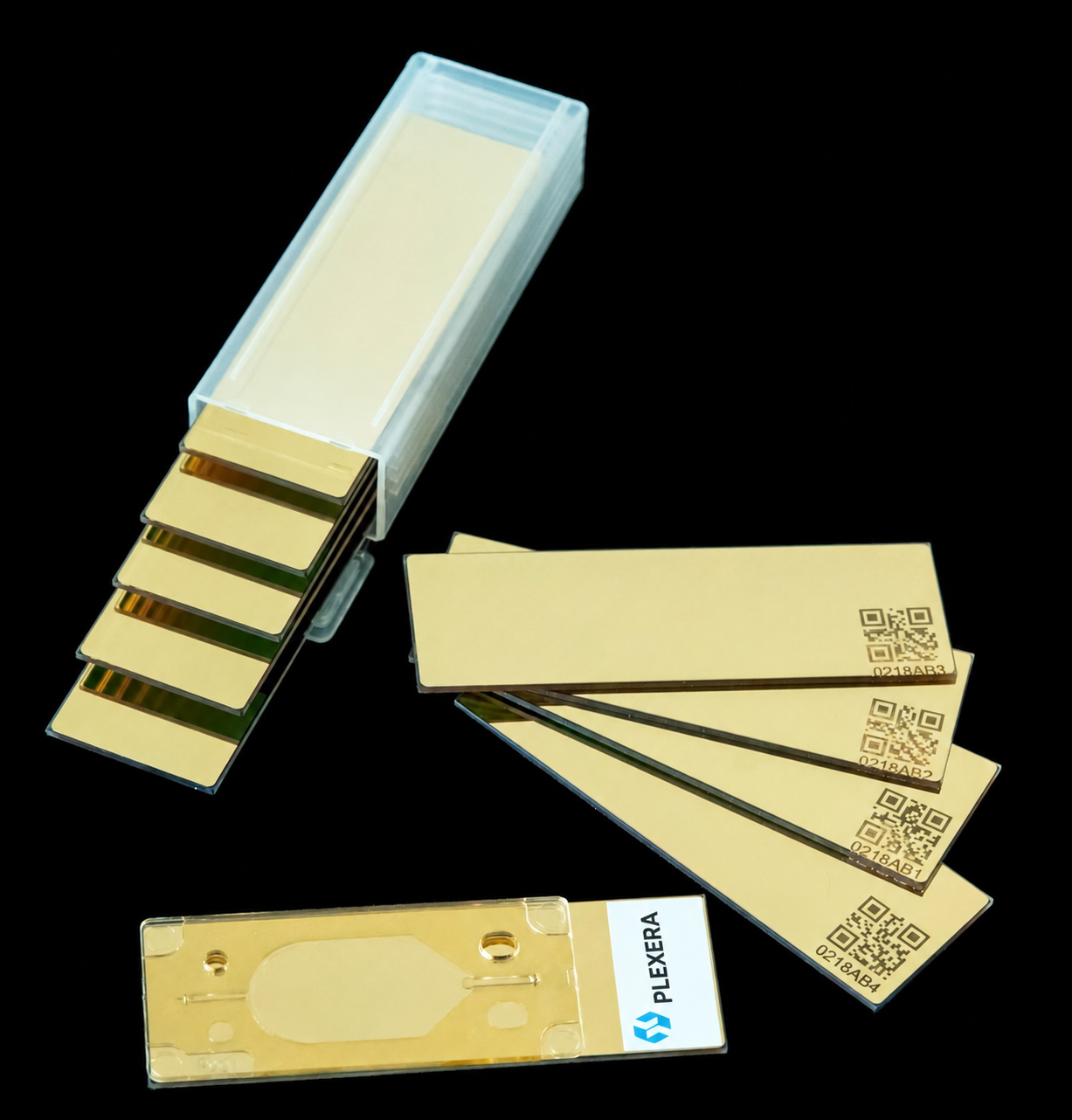
Plexera sensor chips with multiple gold and silver surface formats
Sensor substrates and application-specific chip formats

SURFACE CHEMISTRY

A sensor surface matched
to the molecular format.

Surface chemistry controls how molecules are immobilized, how well their binding sites remain accessible and how nonspecific adsorption is managed.

  • Gold and silver SPRi substrates
  • Three-dimensional polymer surfaces
  • Zwitterionic antifouling surfaces
  • Carboxyl and epoxy coupling
  • His-tag and biotin capture
  • Photocrosslinking for small molecules

HIGH-DENSITY ARRAY FABRICATION

Controlled printing from
standard source plates.

PlexJet uses multi-pin contact printing to transfer samples from a 384-well source plate to defined positions on the chip surface.
384-well
Source-plate format
~40 min
Per source plate
3,840
Spots per chip
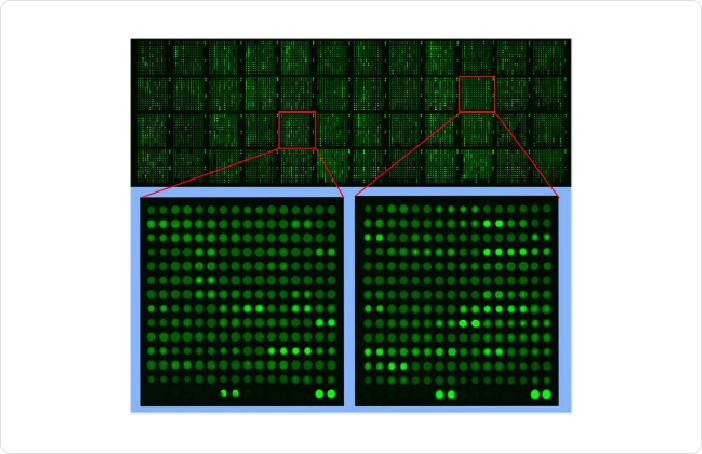
High-density microarray imaging with enlarged spot regions
Representative high-density microarray imaging

HIGH-THROUGHPUT CFPS

Parallel protein production
for sequence-defined libraries.

Cell-free protein synthesis connects DNA templates to purified, array-ready ligand proteins within a parallel workflow.

  1. 01DNA templatesSequence-defined inputs
  2. 02Parallel CFPSCell-free protein synthesis
  3. 03PurificationProtein preparation
  4. 04Quality controlArray-ready ligands
  5. 05SPRi workflowComparable kinetic data

VHH / scFv / IgG / Proteins / Engineered binders

PARALLEL DATA PROCESSING

Every sensing spot becomes
a kinetic trace.

Parallel processing converts each image sequence into spot-level responses, concentration-resolved sensorgrams and fitted kinetic parameters.

01Image sequenceReflected-light changes over time
02Signal extractionResponse at every sensing spot
03Sensorgram
04Curve fittingKD, kon, koff and Rmax

MOLECULAR COVERAGE

One technology stack.
Multiple molecular classes.

  • 01Proteins
  • 02Antibodies
  • 03VHH
  • 04Peptides
  • 05Small molecules
  • 06DNA / RNA
  • 07Glycans
  • 08Aptamers

NEXT-GENERATION FORMAT / COMING SOON10,000 spots / chip